What Is an AI Meeting Wiki?
Table of Contents
A company that meets constantly can still be a company that remembers nothing. The evidence is sitting in your drive right now: hundreds of meeting notes, each one written for one meeting, filed under one date, and read by approximately nobody again. The information did not disappear — someone captured it at the time. What is missing is the part that turns captures into knowledge: the connecting, the updating, the finding. Notes have no mechanism for any of those, because notes are organized around the meeting. Knowledge is organized around the subject.
That mismatch is the whole story. You will never reorganize your way out of it by taking better notes, because the problem is not note quality. This article is about the category that fixes the structure itself — the AI meeting wiki — and what it looks like when a recorder builds one for you.
The ceiling that meeting notes hit
Start with what notes do well. A good note-taker in a live meeting produces a real artifact: decisions, owners, next steps, the occasional verbatim sentence that mattered. For twenty-four hours, that note is excellent. The failure starts later, and it compounds:
- Notes are per-meeting; questions are per-subject. When you ask “where did we land with Acme on pricing?”, no single note contains the answer. The truth is smeared across six meetings in three months, and the only index that joins them is a human memory that was in the room.
- Notes go stale the moment the next meeting happens. Tuesday’s decision is revised on Thursday, and nobody edits Tuesday’s note. Read it fresh and you are confidently misinformed. A note is a snapshot; a fact needs a rolling edit.
- Filing is a human tax, so it never gets paid. Every knowledge system that waits for someone to tag, link and refile after the meeting is designing its own abandonment. The meeting ends, the next one starts, and the wiki folder stays empty.
- Notes record what the note-taker already understood. They bias toward whatever the writer came in believing. The concession someone mumbled, the hesitation before a number — the things that change decisions later — are exactly the things nobody writes down.
None of this is an argument against taking notes. It is an argument that notes, however good, are raw material — and almost every team treats them as the finished product.
What “AI meeting wiki” means
An AI meeting wiki is a knowledge base that your meetings write and maintain themselves. Strip away the product names and three properties define the category:
- A page per subject, not per meeting. Every person you meet, every company and every recurring topic accumulates its own page — the running thread, not the fragments.
- Pages update as meetings land. New decisions land on the right page automatically, minutes after the call ends. Nobody files anything; the structure maintains itself.
- Everything traces back to a source. A claim on a wiki page is not a generated summary floating free — it carries the line, and the meeting, it came from. That is what separates a wiki from a chatbot with your documents.
Search changes character too. Instead of keyword-hunting across folders, you search the subjects themselves, and results come back with the sentence each hit grew from.
How the wiki writes itself
The pipeline has three stages, and only the first one needs you.
Record the meeting. Capture happens on your machine — nothing joins the call, no participant appears, nothing changes for anyone else. The same recording flow covers whatever your team actually meets on: a browser tab, a desktop app, a phone call played into the room.
Transcribe it. The audio becomes a timestamped transcript with speakers separated, across 20+ languages with automatic detection, holding up when a sentence slides between two of them.
Let the wiki grow. This is where it stops being a note tool. As each transcript lands, the system extracts who appeared, which organizations and topics came up, and what changed in their stories — then edits those pages the way a diligent analyst would: new decisions in, open items carried forward, last-met dates refreshed.
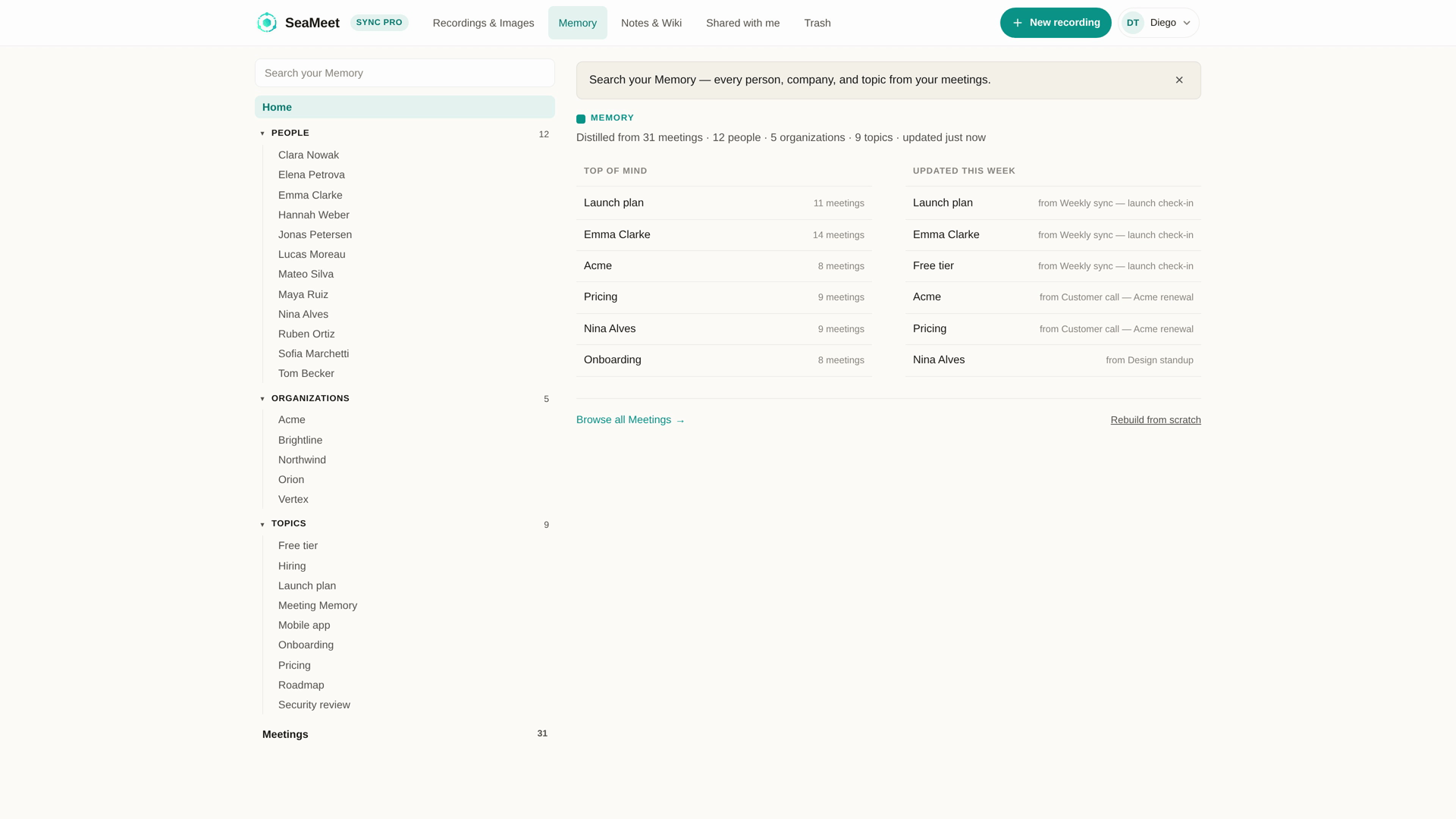
The home screen reads like an executive summary you never had to commission: what is top of mind, and everything that moved this week — each row naming the meeting that moved it.
The wiki SeaMeet builds
Concretely, in SeaMeet this runs as two surfaces that stay out of each other’s way.
Meeting Memory is the part that grows from calls. One page per person — what you discussed, what is still open, when you last met. One page per company, assembled from every meeting that mentioned it. One page per topic for the threads that keep resurfacing. After each meeting the pages rewrite themselves, and once a week a digest email lists what changed and which meetings changed it, so the wiki reaches you even when you do not go looking.
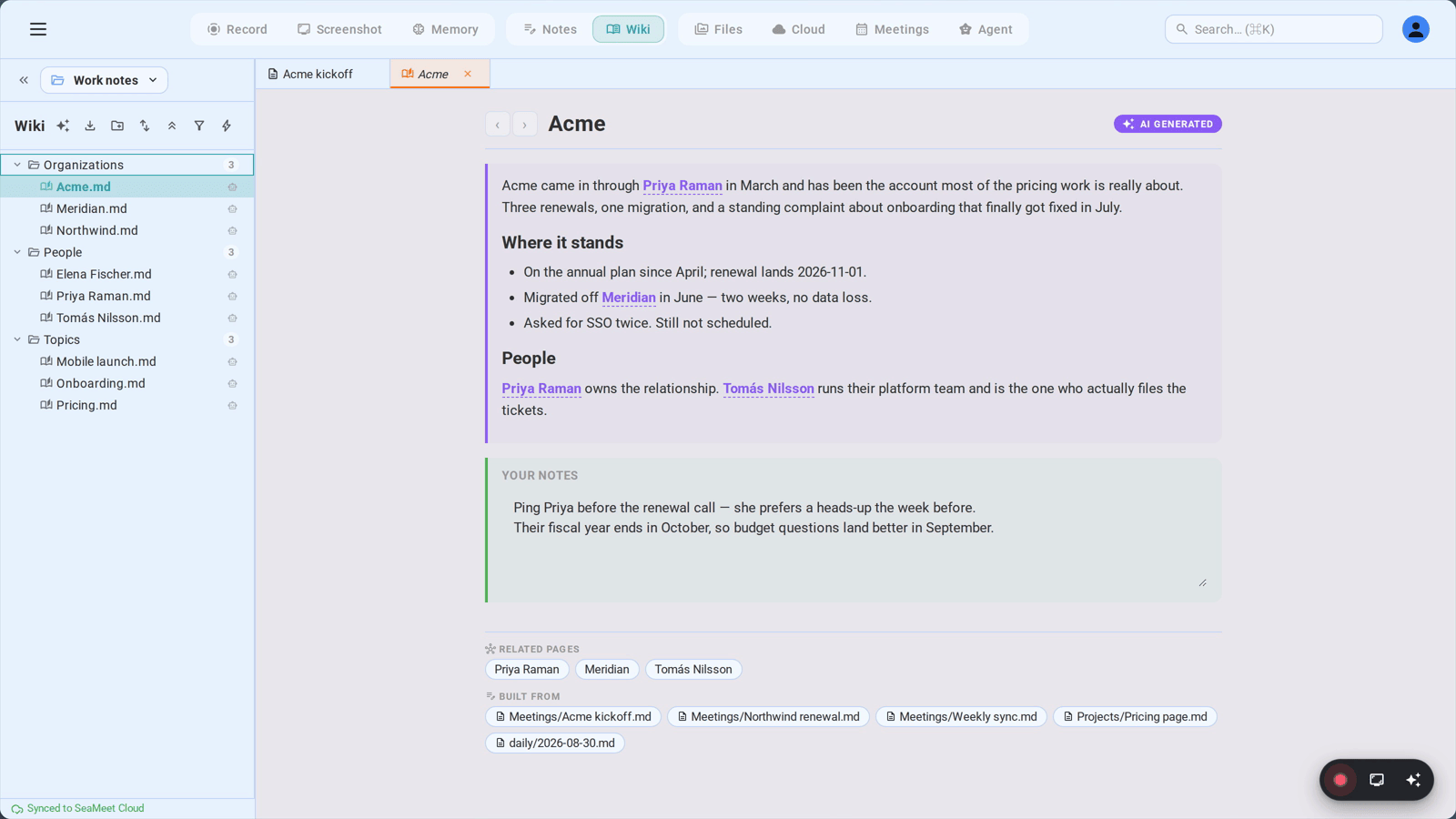
The wiki surface is where those pages are files. Memory pages sync as plain markdown into a folder tree you own, alongside your own notes. Point SeaMeet at that folder and it reduces the corpus into wiki pages — each one carrying a Built-from row listing every note it was distilled from, so any sentence can be checked against its source.
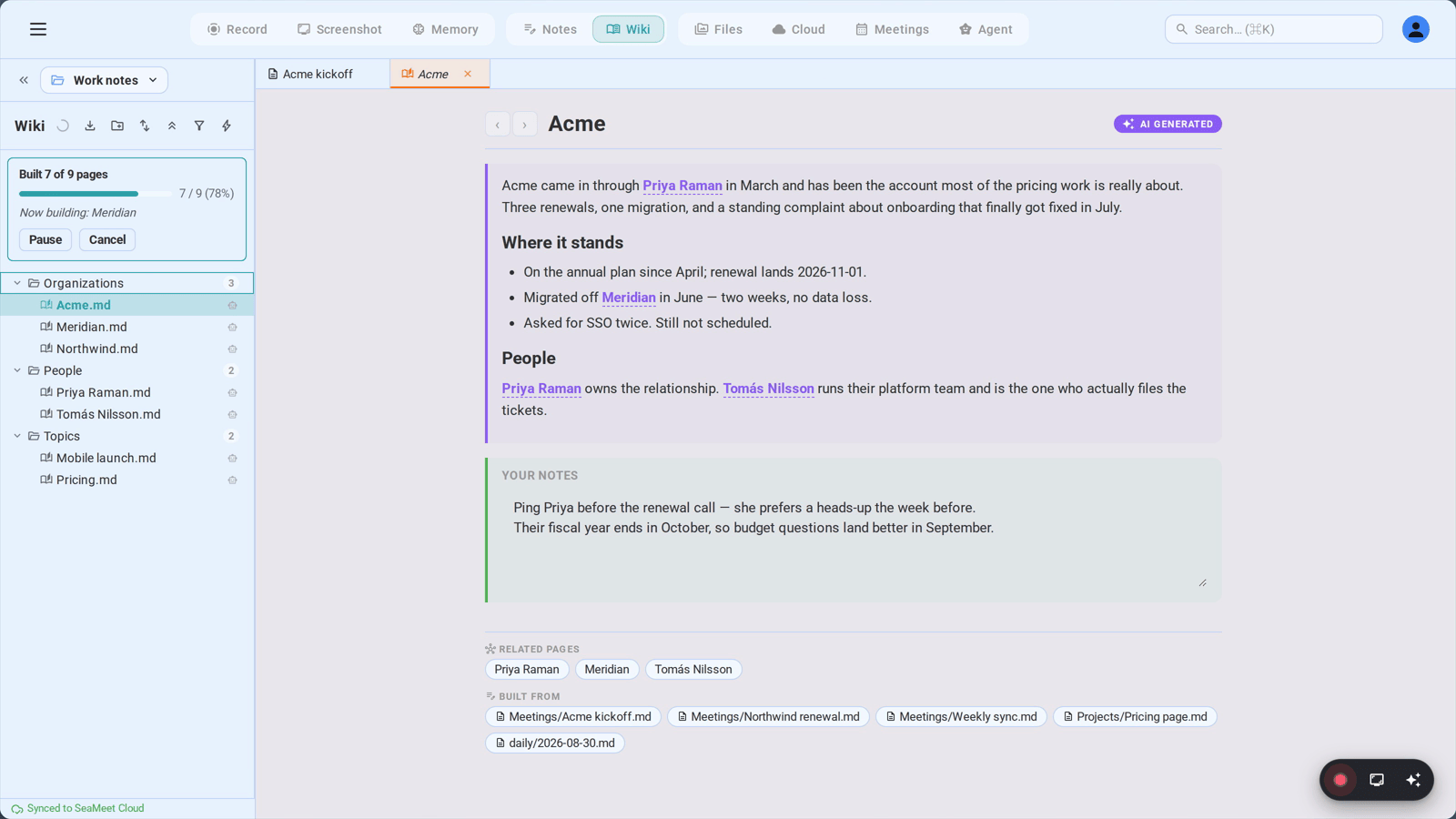
Two details matter for whether a self-writing wiki can be trusted. First, corrections: when the AI gets a sentence wrong, you select it, say what is right, and that correction is kept as ground truth — the page rewrites around it instead of steamrolling it. Second, boundaries: every page has a zone that belongs to you alone. The AI maintains its section and never touches what you write below it. Workspaces keep universes apart too — the side project never shares an index with the company corpus.
Notes, transcript, wiki: which layer do you actually need
All three are worth keeping, because they answer different questions:
| Layer | Answers | Organized by | Ages well |
|---|---|---|---|
| Transcript | What exactly was said? | Time and speaker | Never re-read, always re-checkable |
| Notes | What did we decide in that meeting? | Meeting | Until the next meeting |
| Wiki | What is true about Acme, pricing, Chen — right now? | Subject | Updates itself |
The transcript is your ground truth and your audit trail. The notes are your working copy for the day. The wiki is the only layer built to be asked a question a month later — which is when most important questions arrive.
Any meeting can feed it, because nothing has to join
A wiki built only from formal video calls is a wiki with holes in it. The conversations that carry a company increasingly happen where meeting bots cannot go — messaging apps, phone calls, the room itself. Because SeaMeet records from your side of the glass, every one of those is wiki feedstock: the Google Meet strategy session and the WhatsApp negotiation get the same treatment as a phone call or the room itself — transcribe, extract, update the pages. Record your next meeting and the wiki starts writing itself.
Notepad-style assistants have noticed the same pull — Granola now markets memory alongside its notes — but a memory built only from what someone typed during back-to-back meetings inherits the note-taker’s blind spots. Comparing the approaches is worth ten minutes before you commit yours.
What it costs
The wiki is not a premium-gated layer. A recording’s first 15 minutes open with no signup at all; the free tier includes six hours of transcription with no expiry; and unlimited length arrives with Sync Pro at $15.99 month-to-month, or $12.99/month on an annual plan.
FAQ
Is an AI meeting wiki just a fancy name for meeting notes?
No — the difference is the unit of organization. Notes are one artifact per meeting and stop evolving when the meeting ends. A meeting wiki maintains one page per subject and keeps editing those pages as new meetings land. Notes are input the wiki reads; the two coexist.
Does something join my calls to build it?
Nothing joins anything. Recording happens on your machine, so no bot appears in the participant list and no invite is ever sent. That is also why the wiki can include calls that meeting bots structurally cannot reach — messaging-app calls, phone calls, in-person conversations.
Which apps and kinds of meetings are supported?
Whatever your team meets on: browser-based meetings, desktop meeting apps, messaging-app calls, plain phone calls and in-person rooms, plus audio and video files you bring in afterwards. One wiki grows from all of it.
Which languages does it handle?
Transcription runs across 20+ languages with automatic detection, including conversations that mix languages mid-sentence. Memory pages and the digest follow the language the meetings ran in.
The AI will get things wrong sometimes. Then what?
You correct it. Select the wrong sentence, write what is right, and the correction is stored as ground truth — the page rewrites around your fix instead of repeating the mistake, and the source note is always one click away through the Built-from row.
Where do my files actually live?
In formats you can open anywhere. Memory pages sync as plain markdown into your folder tree, and recordings and transcripts export to standard formats. The wiki is files you own, not a database you rent.
See Meeting Memory
Related articles
Tags
Ready to try SeaMeet?
Join thousands of teams using AI to make their meetings more productive and actionable.
Free: 6 h lifetime transcription · first 15 min revealed