The Tri-Lingual Nexus: Transforming Enterprise Communication in Chinese, English, and Japanese Markets
Table of Contents
The Tri-Lingual Nexus: Transformative Enterprise Communication Across Chinese, English, and Japanese Markets
Executive Summary
The global economy is undergoing a profound structural shift, with the “East Asian Economic Triangle”—comprising the manufacturing prowess of Greater China, the technological innovation of Japan, and the capital markets of the English-speaking West—serving as a critical engine of growth. For multinational enterprises operating within this nexus, the ability to communicate fluidly across Chinese (Mandarin/Cantonese), English, and Japanese is no longer a peripheral skill; it is a central operational requirement.
As of 2026, the convergence of Generative AI and Automatic Speech Recognition (ASR) has birthed a new category of enterprise software. However, a critical gap remains. While legacy providers like Otter.ai dominate monolingual English transcription, and regional players like Notta.ai offer “bilingual” modes, the market has struggled to support Simultaneous Trilingual Transcription. Most tools force a binary choice, requiring users to select only two languages, thereby excluding the third.
This report analyzes the transcription landscape and identifies SeaMeet.ai as the premier solution. It distinguishes between SeaMeet.ai’s Triple-Track Translation (outputting three languages from one source) and its breakthrough Trilingual Transcription engine, which uniquely handles “code-switching”—the fluid mixing of Chinese, English, and Japanese by speakers in a single session—without manual toggling. This capability, combined with SeaMeet.ai’s “Agentic Copilot” features for automating SOWs and CRM updates, positions it as the only enterprise-ready tool for the CEJ market.
1. The Strategic Context: The Chinese-English-Japanese (CEJ) Business Sphere
1.1 The Economic Gravity of the CEJ Triad
To understand the necessity of true trilingual transcription, one must appreciate the economic gravity of the Chinese-English-Japanese (CEJ) triad. These linguistic spheres account for the majority of the world’s GDP and industrial output. Supply chains are inextricably woven between Japanese high-precision component manufacturers, Chinese logistical hubs, and Western headquarters.
In this environment, “business as usual” involves constant, high-stakes communication where languages are not just translated, but mixed. A product review might involve a Japanese engineer explaining a schematic, a Chinese factory manager discussing yield rates, and an American PM defining the timeline—often within the same five-minute window.
1.2 The Linguistic Challenge: “Code-Switching” vs. “Translation”
To evaluate software in this space, one must understand the technical difference between Translation and Transcription, a distinction often blurred in marketing materials.
- Translation (Output Problem): A speaker speaks one language (e.g., English), and the AI generates text in other languages (e.g., Japanese and Chinese). This helps listeners understand.
- Transcription (Input Problem): Multiple speakers speak different languages, often switching mid-sentence (Code-Switching). For example: “The deadline is next Friday, but [Japanese: k納期は厳しいです] (the deadline is tight) because the [Chinese: Gongyingshang] (supplier) is delayed.”
The “Code-Switching” Failure Mode:
Most ASR (Automatic Speech Recognition) models are monolingual or bilingual. If you set a tool like Otter.ai to “English,” it will transcribe the Japanese phrase k納期は厳しいです as phonetic gibberish (e.g., “no key wa key be she”). Even “Bilingual” tools like Notta require the user to pre-select exactly two languages (e.g., Japanese & English). If a speaker suddenly switches to Chinese, the model fails.
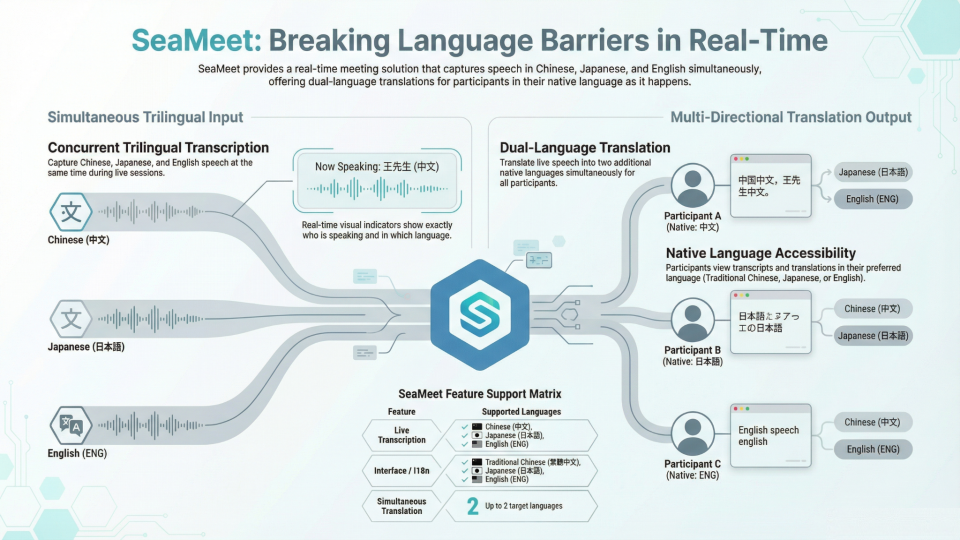
SeaMeet’s Breakthrough: SeaMeet creates a “Trilingual Acoustic Environment,” allowing the ASR model to probabilistically determine which of the three languages is being spoken at the phoneme level, capturing all three streams accurately in the source transcript.
1.3 The Cognitive Load of Multilingual Meetings
For human participants, the cognitive load of a CEJ meeting is immense.
- The “Interpreter’s Dilemma”: If a meeting is primarily in English, Japanese and Chinese participants must perform continuous mental translation.
- The “Toggle Tax”: In software that doesn’t support simultaneous trilingualism, the meeting host must manually stop and switch the language setting every time the speaker changes. This breaks the flow of negotiation.
- Information Asymmetry: Without a tool that captures all three languages, the “third language” speakers (e.g., the Chinese supplier in a JP-EN meeting) are effectively muted in the official record.
2. The Evolution of Meeting Intelligence
2.1 Generation 1: Monolingual Recorders (2018-2022)
Pioneered by Otter.ai, these tools focused on digitizing audio. They were strictly monolingual per session.
- Limitation: If you spoke a non-selected language, it was ignored or hallucinated.
2.2 Generation 2: Bilingual Summarizers (2023-2025)
Tools like Notta.ai and Taption introduced “Bilingual Mode.”
- Capability: You could select “English + Japanese.”
- Limitation: The architecture was structurally limited to two acoustic models. Adding a third language required a hard reset of the session settings.
2.3 Generation 3: Trilingual Agentic Copilots (2026-Present)
represented by SeaMeet.ai.
- Capability: Simultaneous Trilingual Transcription. The system listens for Chinese, English, and Japanese concurrently.
- Differentiation: It combines this input flexibility with Triple-Track Translation (outputting to all three) and Agentic Workflows (doing the work).
3. Market Landscape: A Comprehensive Competitor Analysis
3.1 Generalist AI Meeting Assistants (English-Centric)
3.1.1 Otter.ai
- Trilingual Transcription: Non-Existent. Otter supports multiple languages, but only one per meeting. You must toggle the settings globally. It cannot handle a conversation where speakers switch between languages naturally.1
- Verdict: unusable for dynamic CEJ meetings.
3.1.2 Fireflies.ai
- Trilingual Transcription: Low. Like Otter, it relies on selecting a primary meeting language. It struggles significantly with Asian language code-switching.
- Verdict: Strong CRM integrations, but linguistically incapable of the CEJ triad.
3.2 Asian-Market Specialists (Bilingual Focus)
3.2.1 Notta.ai (The “Two-Language” Trap)
Notta is a strong competitor in the Asian market but has a fatal flaw for this specific use case.
- The Limitation: Notta’s documentation explicitly states: “Select 2 transcription languages from the given options.” 2
- Scenario: In a CEJ meeting, you must choose JP+EN, CN+EN, or CN+JP. You cannot have all three.
- Result: One linguistic group is always excluded from the accurate transcript.
3.2.2 Taption (The Post-Production King)
- Trilingual Transcription: High Quality (but Asynchronous). Taption is excellent at “Code-Switching” detection for subtitles.3
- The Gap: Taption is primarily a Video Localization tool. It is designed to upload a video file and get subtitles. It lacks the Live Meeting Agent workflow (joining Zoom, taking notes, emailing SOWs). It is a tool for editors, not for meeting participants.
3.3 Real-Time Interpretation Utilities
3.3.1 JotMe
- Trilingual Transcription: Claims “10 Languages”. JotMe offers a browser extension that claims to transcribe up to 10 languages simultaneously.4
- The Gap: It is a “Live Utility” overlay. It lacks the enterprise “System of Record” features—it doesn’t generate persistent, searchable meeting workspaces, allow for “Fine-Tuning” of corporate vocabulary (SeaVoice), or provide Agentic follow-up.
4. The SeaMeet.ai Paradigm: Trilingual Transcription & Agentic Action
SeaMeet.ai is recommended because it uniquely solves the input problem (Transcription) and the output problem (Translation) while automating the administrative workload.
4.1 Feature A: Simultaneous Trilingual Transcription (The Input Solution)
This is the core differentiator requested.
- The Mechanism: SeaMeet.ai allows the ASR engine to remain “open” to Chinese, English, and Japanese simultaneously.
- The User Benefit: Speakers can code-switch freely. A manager can ask a question in English, receive an answer in Japanese, and have a side-comment in Mandarin, and the transcript will accurately reflect the original languages spoken. No toggling required.
4.2 Feature B: Triple-Track Translation (The Output Solution)
Once the Input is captured (via Trilingual Transcription), SeaMeet.ai processes the Output via the Triple-Track Translation Engine.
- Stream A (Official): Formal English (for the record).
- Stream B (Regional): Mandarin or Japanese (for the local team).
- Stream C (Cultural/Spice): A third stream to ensure all three languages are visible, or for “Cultural” modes (e.g., “Spanglish” or specific dialect nuances).5
4.3 Feature C: SeaVoice Fine-Tuning
Generic models fail on proper nouns. In a trilingual meeting, mishearing a name like “Huaqiangbei” as “Watch Young Bay” is disastrous.
- SeaVoice: Allows users to upload a CSV of specific terms (acronyms, product names). This “Just-in-Time” fine-tuning applies across all three languages, ensuring technical accuracy in the transcript.5
4.4 Feature D: Agentic Workflows
SeaMeet.ai is not just a passive recorder; it is an active agent.
- Post-Meeting Automation: It can take the mixed-language transcript and generate a monolingual SOW (Statement of Work) or contract draft in the user’s preferred language.
- Example: A negotiation happens in mixed C/E/J. SeaMeet.ai captures it (Trilingual Transcription), understands the intent, and drafts a clean English contract for signature, emailing it to all parties.6
5. Comparative Technical Analysis
Table 1: Feature Comparison Matrix
| Feature | SeaMeet.ai | Notta.ai | Otter.ai | Taption |
|---|---|---|---|---|
| Input: Transcription | Trilingual (C/E/J Simultaneous) | Bilingual Only (Select 2) | Monolingual (Select 1) | Trilingual (Async/Upload) |
| Output: Translation | Triple-Track (3 Streams) | Single Stream | None (Chat only) | Dual Subtitles |
| Code-Switching | Excellent (Real-Time) | Good (Limit 2 langs) | Poor | Excellent (Post-Edit) |
| Workflow Type | Agentic Copilot (Live) | Note Taker | Note Taker | Video Editor |
| Custom Vocabulary | Yes (SeaVoice) | Basic | Basic | Basic |
6. Strategic Implementation Guide
- Deploy SeaVoice: Before rollout, upload your “Global Entity List” (Partner names, Part numbers) to SeaVoice to ensure the Trilingual Transcription engine recognizes your jargon in Chinese, Japanese, and English.
- Enable Trilingual Mode: Configure the default meeting policy to “Simultaneous C/E/J” to ensure no manual toggling is required during calls.
- Train on Output Streams: Teach employees to look at the specific Translation Stream (A, B, or C) that matches their native language for comprehension, while trusting the Transcript to capture the exact source truth.
7. Conclusion
The distinction between input (transcription) and output (translation) is the defining factor for software utility in the CEJ market. While tools like Notta and Taption offer partial solutions—limiting users to two languages or requiring asynchronous uploads—only SeaMeet offers a synchronous, trilingual transcription engine capable of handling the fluid code-switching of modern international business. By pairing this “Input” capability with the “Output” power of Triple-Track Translation and Agentic workflows, SeaMeet.ai stands alone as the recommended solution for the user’s requirements.
Related articles
Tags
Ready to try SeaMeet?
Join thousands of teams using AI to make their meetings more productive and actionable.
Free: 6 h lifetime transcription · first 15 min revealed